Meet Sonia
I know what it’s like to be the woman who copes.
For years, I was very good at being capable.
Work. Marriage. Motherhood. Family. Responsibility. Life.
I got on with it.
And when life became more complicated, I got even better at getting on with it.
I didn’t think of myself as someone carrying too much. I was the oldest daughter. I was a nurse. I was a mother. People needed me.
Of course I could cope.
In fact, for a long time I thought that was simply what capable women did.
Notice that we’re not making you a victim of your own life. That’s important.
You were capable. You did cope. Those qualities served you.
We’re questioning the cost, not rewriting your history as pathology.
Then: the washing line
This is where I would use it — quietly.
Not a dramatic trauma story. No violins. No “rock bottom”. Just the moment.
Until one day, coping looked rather different.
My mother was terminally ill. I’d had a difficult night with her and, the following day, I was outside hanging washing on the line.
My youngest brother came out.
And I burst into tears.
There I was, in the middle of something utterly ordinary, carrying something that wasn’t ordinary at all.
I had become so accustomed to keeping going that even I hadn’t fully noticed what I was carrying.
Looking back, I can see the Rulebook at work.
You’re the oldest daughter.
You’re a nurse.
Of course you’ll cope.
Of course you’ll look after everybody.
What was I thinking? 😄
Nobody had actually handed me those rules.
I’d absorbed them.
I spent 45 years working in healthcare, including as an NHS Nurse Practitioner.
I met thousands of people. And if all those years taught me anything, it’s that people are complicated.
We don’t arrive as a symptom, a diagnosis, a hormone level, a number on the scales or a neat little problem waiting to be solved.
We arrive with bodies, histories, relationships, responsibilities, losses, expectations, habits, fears and lives.
That’s one reason I’ve gathered such a broad toolbox over the years — from clinical healthcare and women’s health to functional medicine health coaching, emotional work, hypnotherapy and complementary approaches.
But the toolbox isn’t the most important part.
Knowing when something might be useful — and when it isn’t — is.
The question I’ve learned to ask isn’t:
“What can we do?”
It’s:
“What does this woman need?”
I’m not here to tell you who you should become.
I won’t hand you another Rulebook.
I won’t pretend one approach works for every woman.
And I won’t want change for you more than you want it for yourself.
What I can do is listen. Ask good questions. Notice things. Share what 45 years have taught me. Offer practical tools when they’re useful. Challenge you when you’re making yourself smaller than you need to be.
You can, as I sometimes say, borrow my head.
But you keep your own.
I’ve learned that coming back to yourself doesn’t necessarily mean blowing up your life.
Sometimes it’s five quiet minutes in the car before you go inside.
Sometimes it’s asking for help.
Sometimes it’s questioning a rule you’ve obeyed for decades.
And sometimes you simply know:
I’m done.
The important thing is learning to hear the difference between what everybody else expects of you and what you know for yourself.
I’m still a capable woman.
I haven’t stopped caring about people. I haven’t stopped being responsible. And I certainly haven’t got life perfectly sorted.
I’ve simply learned that being capable doesn’t mean I have to carry everything.
And perhaps that’s what brought you here too.
Not because you want to become a completely different woman.
But because you’d quite like to find the one who’s been there all along.
You don’t need to be more YOU
You need room to be more YOU.
And you get to decide what that looks like.
Coming back to yourself — gently, in your own time.
Don't believe me, believe them

Felt at ease, heard, understood and supported; collaborative experience
Cathy
Founder and CEO. MissionZ Health

Calm support, clear explanation, questions welcomed, process manageable
Rhianne
Risk Consultant

Greater awareness, calm, sleep improvement and practical changes
Nikki
RTT Therapist
Sonia Jenkins is an author, former NHS Nurse Practitioner and Modern Midlife Elder who helps highly capable midlife women who have spent years holding everything together come back to themselves. Her work brings together 45 years in healthcare with women's health, functional medicine health coaching, behaviour change and emotional wellbeing.
Commonly asked questions
What is Sonia Jenkins' professional background?
45+ years healthcare; former NHS Nurse Practitioner; primary care; women's health; chronic disease management; Functional Medicine Certified Health Coach; behaviour change/emotional wellbeing; author; relevant professional training.
Why does Sonia work with midlife women?
Because I know how easy it is for a capable woman to become so busy being who everyone else needs her to be that she loses sight of herself. After more than 45 years working in healthcare, I've seen how physical health, emotional wellbeing, relationships, responsibilities and identity can collide in midlife. I want women to have the space to ask not only, “What's happening to me?” but also, “What do I want now?”
What does Sonia mean by Modern Midlife Elder?
A Modern Midlife Elder isn't someone with all the answers. For me, it's someone who has lived enough, learned enough and observed enough to have something useful to share — without needing to be right. I bring my professional knowledge, lived experience, perspective and curiosity to the conversation, but the woman in front of me remains the expert on her own life.
What is The Sonia Way?
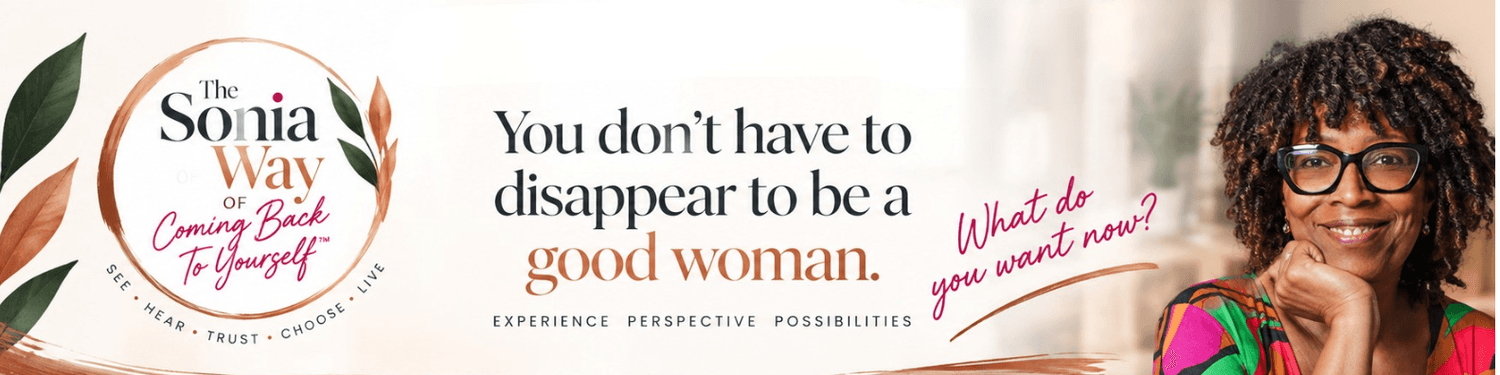
The Sonia Way is how I work: SEE → HEAR → TRUST → CHOOSE → LIVE. It starts with seeing and hearing the whole woman rather than reducing her to a symptom, diagnosis, role or problem to solve. From there, we create the space for her to trust her own knowing, make choices that fit the woman she is now, and begin living those choices in her own way.
What does “Borrow my head. But you keep your own” mean?
It means you can borrow my experience, perspective, questions and very large toolbox while you're figuring things out — but I'm not here to tell you who to be. I'll offer what I know and challenge you when necessary, but you remain the author of your own life. You can borrow my head. You don't hand me yours.